
| |
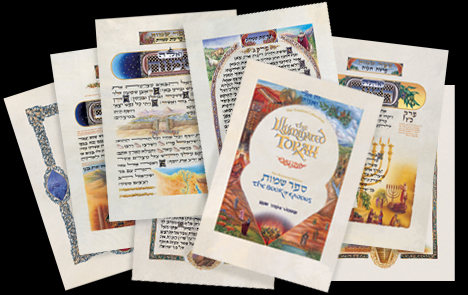
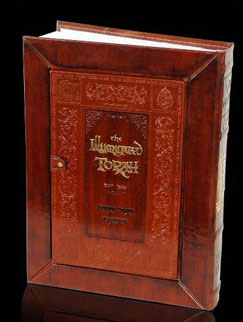
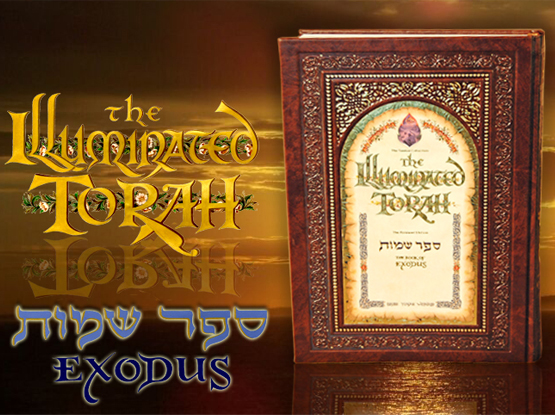
The Illuminated Torah – The Project and the Vision
A work of the magnitude of The Illustrated Torah
did not just happen; the constant sources of
heavenly direction gave all those involved the
impetus and the inspiration to see that it was a
rare undertaking indeed. In truth, the project
did not start out as an artistic endeavor on the
Torah, but rather on the Hebrew
Aleph-Bet. The Tessler family of
Chicago, which had subscribed to earlier
illuminated works, particularly Pirkei Avos,
wished to commission a project to mark the fiftieth
wedding anniversary of first names, or Mr. and
Mrs. Name Tessler. Any couple reaching
such a milestone has cause to celebrate, but to the
Tesslers, who had survived the horrors of the
Holocaust in Eastern Europe, it was particularly
poignant.
[I’m condensing the next two paragraphs – the story
of what did not work is not as compelling as what
did! If you feel it’s important to keep the entire
process in, I’ll restore the missing material
The plan was to begin working on individual Hebrew
letters, as described in the
Midrash, commentaries, and Talmud. Yet
early on, I sensed that mining the disparate pieces
of information from the vast storehouses of Judaic
literature would not yield a cohesive body of
material. While exciting in its many
dimensions, the Aleph-Bet does not have a
firm text with which to work.
I suggested to the Tesslers that we rechannel the
efforts of the project, and move in a slightly
different direction. Since the Hebrew alphabet
is the DNA of the Torah, and indeed the forces with
which the world itself was created (see Talmud,
Berachot 55a and Sefer Yetzirah), a work
on the Torah itself seemed a logical extension.
Would it be possible to illuminate the entire Torah?
We all agreed to the challenge, though it was at
once awesome, elevating, and daunting. A
preliminary timetable was constructed, and we were
ready to embark on a project that had never been
attempted before. Over the centuries, lavishly
illuminated haggadot, megillot, Bibles,
Psalms and other texts had seen the light of day,
but the scope of our endeavor would be unparalleled
in the history of manuscript illumination. We would
attempt a work that would encompass the artistic
dimension in a most majestic fashion, based upon
and accompanied by profound Midrashic commentary
and insights.
I realized that the task was enormous, larger than I
was. Though in earlier projects I personally
had executed all aspects of the art, calligraphy,
research, and design, for this momentous venture I
would have to assemble a team. One of my
children was disappointed when told of my decision:
“But Abba, it won’t be all your work if you use
other artists!” I explained that a project
that has to convey the magnificence of Torah must
reflect not my most beautiful work, but His.
If pooling the combined talents of several artists
would reflect a more exalted vision of Torah, that
would be the best choice.
Throughout the project, time and time again, I
received small heavenly approbations, little
reminders that the work was being directed by the
Designer with a global perspective. In
November 2003, I took a trip to Israel with my wife.
We arrived at the airport on a Monday afternoon, a
non-peak travel time. The airport was
uncharacteristically quiet, and we headed for the
stand where a sherut, a communal taxi shared
by passengers going from the airport to various
destinations, could be found. Each van seats
approximately eight people, depending on the amount
of luggage they brought, and almost never did
a sherut leave without its full quota of
passengers. Each passenger pays a set fee for
this service; the more heads, the greater the fee.
Before we knew it, our bags were placed in the back
of a van, we had settled in the front, and it took
off with only the two of us as passengers. As
we headed through the terminals, it picked up one
more passenger, a young Chassidic man, holding a
small case. He settled in the back of the van,
and our threesome departed for Jerusalem. Out of the
corner of my eye, I spotted our traveling companion,
as out of his satchel he pulled – an elaborately
illuminated parchment scroll! With a comment
to my wife, “I have to speak to this guy,” I headed
to the back of the van to talk shop.
After exchanging
pleasantries, I perused the high quality of the art
he was holding, executed by his talented team of
artists. I had heard of the work of this
artist, Avrohom Chazin, and he had heard of mine,
and we agreed to be in touch via e-mail. The
initial encounter had been fortuitous, and it was a
portent of remarkable things to come.
Some months later, I scheduled another trip to
Israel, this time to secure an artistic team to
assist me with The Illuminated Torah. I
had arranged meetings with representatives of two
different art groups, one headed by Avrohom Chazin,
my new friend from the airport. Both teams had
artists that were highly trained in the finest
Russian schools of art, but I needed more than mere
talent. I was looking at style, the type of
illumination done, and how well my team coordinator
and I would be able to interface with the artists.
I’ll be the first to admit that artists can
sometimes be confounding – creativity does
not always go hand-in-hand with understanding
production deadlines. Additionally, this
international effort had to rely on artists
faithfully executing the detailed sketching and
design I had done, with color application that
reflected my intent and color palette. The
production coordinator would have to be able to
accurately communicate my intents to the artists
(often in Russian!), be uncompromising in his
standards, attentive to every detail, willing to
work whenever necessary to meet deadlines, and be
sensitive to the subtleties in Midrashic images I
wished to portray. In Avrohom Chazin of
ArtChazin I found all this – and much more.
Every shidduch, or match, is made in heaven,
and the import of our serendipitous meeting in the
sherut to Jerusalem was beginning to bear fruit.
Avrohom, a talented scribe, was born to an artistic
Russian Jewish family. Not yet thirty, his
youthful enthusiasm and buoyant energy, together
with his quest for excellence, made him my perfect
production partner to create The
Illuminated Torah.
From the outset, the historic nature of this project
loomed larger than life. Because of the
opportunity and the challenge, I approached the work
with awe and reverence. And I found that
this sense was shared by everyone associated with
it. In choosing the appropriate craftsmen
to execute the printing of the project with all of
its accoutrements, we were often told, “Price is not
our primary consideration; we want to be involved in
helping bring this project to fruition.”
Reflections and Acknowledgments
“One who learns from his friend even one chapter,
one halachic decision, one verse, one word, or even
one letter is obligated to treat him with respect.”
(Avot 6:3) How does one possibly
acknowledge the contributions of the hundreds of
sefarim/holy books, individuals, and teachers
who impacted upon this work directly or indirectly?
I have had the merit to be engaged intensively in
this project for over three years, and I have come
away phenomenally enriched – and greatly humbled.
[I don’t understand
this. Do you mean: Far more than I ever dreamed
possible, I have been afforded the privilege of
exploring the profundity of God’s teachings in the
Torah through the rarified vision of the greatest
commentators of centuries past.]
In The Illuminated Torah, more than any of my
previous projects, I felt that I was mining
treasures of Torah from the finest craftsmen in
history. I have been blessed to be able to
mesh two loves, my love of learning and love of art,
into a singular expression that hopefully reflects
both. The Torah is not meant to be merely
an intellectual exercise, plumbing the depths of
understanding by the mind. It must touch the
mind, the heart, the soul.
The root of the word
is from , meaning teaching or direction. It is
those who learn it and live by its words who acquire
purpose and meaning in their lives. Rabbi
Samson Raphael Hirsch also sees the root as ,
conception. The Torah, like a fetus, is
nurtured, developed, and ultimately born with the
parents’ sense of anticipation of great things to
come. I gratefully acknowledge the assistance
of so many people who have helped me in my labor of
love. I hope they will derive nachat
from the completed work.
By no means is the listing below
configured in order of prominence. Rather, it
traces a chronology of those who have enriched my
journey through Torah, the teachers who instilled in
me a love of learning from my childhood to the
present. My Rebbeim ably imparted their
infectious excitement for God’s message; to my
young mind, the way they lived their lives and
the vibrancy of their teaching breathed a soul into
the Torah. The Illuminated Torah is a
magnificent testimony to this transmission process,
coming alive through a genre that is precious to me.
As an adult, I look back at my childhood days in the
Yeshiva of Hartford with profound respect and
thanks. I owe a debt of gratitude to the
Rebbeim and principals who began my foundation
in learning. The Talmudical Yeshiva of
Philadelphia, headed by Rav Elya Svei and Rav Shmuel
Kaminetsky, guided me in my formative years.
The Mirrer Yeshiva in New York, led by Rav Shmuel
Berenbaum and Rav Shmuel Brudny
charted the next stage of my Torah learning,
providing a haven of learning for me and, later,
for my children. Rav Chaim Shmuelevitz and
Rav Nosson Tzvi Finkel of Mir Jerusalem
deepened my appreciation of Torah learning and
imbued me with a love for our Holy Land.
A special note of appreciation is due to Agudath
Israel Snif Zichron Shmuel, under the guidance of
its esteemed rabbi, Rav Eliezer Ginsberg . I
treasure the extraordinary environment for
learning and prayer that this beit midrash
provides. I have gained immeasurably from my
Rebbe of many years, Rav Shmuel Yosef Lercher,
whose encyclopedic grasp of Torah knowledge gives
one breathtaking glimpses into the breadth of
its beauty. Long-time Torah study partners R’
Shmuel Danziger and R’ Yisroel Hisiger have for
years shared their thoughts in learning, and have
been wonderful friends and colleagues. Rabbi
Hisiger’s exactitude is also evident in his
proofreading much of the original manuscript.
His efforts are greatly appreciated.
I have been privileged to hear words of Torah and
benefit from the wise counsel and direction of two
highly regarded Torah scholars, Rav Elya Brudny ,
R”M [Spell out. R”M not necessarily understood by
all] of Mirrer Yeshiva and Rav Avrohom Schorr ,
Rav of Khal Tiferes Yaakov. I cherish the
opportunity to learn lessons of Torah and lessons
for life from these two individuals who selflessly
give of themselves to others. Rav Schorr
shared his erudition by going over many of the art
pages to ensure that the images were faithful to our
Sages’ interpretations of the verses and commentary.
Patrons and Professionals
The Illuminated Torah is the product of years
involved in learning the intricacies of art, design,
calligraphy, and production techniques. Any
artist must recognize at the outset that his ability
to create is a Divine gift. The skilled
musician, the creative chef, the talented writer, or
an artist who fashions from paints and pigments are
taking their endowment from the Almighty and
transforming it into a finished work of a higher
dimension. The talents they have been given
are raw matter; how they craft it will determine its
value. Credit for the final product is His alone.
Sefer Shemot focuses much attention on the
construction of the Mishkan, the Tabernacle,
the Divine sanctuary for Godliness on earth.
Betzalel, its primary architect, worked with
individuals who were , “wise of heart.” Hands
calloused from arduous labor in Egypt created
masterful vessels and articles that reflected the
true wisdom of their hearts. Their Divinely
inspired creative spirit infused sanctity into gold
and silver. Base matter became consecrated
tools for holiness, creating a sublime perception of
this finely honed craftsmanship.
At a presentation where I revealed my limited
professional training with the audience, one of the
hosts chided me for diminishing the scope of my
work. “To the contrary,” I replied, “it is
important for them to know that my work is a gift
from the Master Artist, and not the result of
training at Pratt School of the Arts.” [The
assumption is that you went to Pratt. Correct? If
not, just say art school.] That being
said, there have been numerous individuals to whom I
credit various aspects of this project, people whose
input, guidance and concern helped a budding artist
develop his work
In my formative high school years, when I began to
develop a fascination for artistic Hebrew letters, I
was unfamiliar with the tools of the trade.
Not knowing any other way, I formed each letter by
drawing the outline of the character, and filling it
in with black ink. Understandably, this
painstaking process led to uneven letters, hours of
grueling faux-calligraphy and frustration. A
talented artist and friend, Nuta Goldbrenner -- now
a principal of the Goldmark Group, a highly
respected graphics and design corporation -- first
introduced me to the world of calligraphic nibs, dip
pens, and structured lettering. His initial
training led to work that has lasted for many
decades. I am forever indebted.
The ArtScroll family has been instrumental to so
many aspects of my work. In the nascent stages
of my development, Rabbi Meir Zlotowitz and David
and Elliot Schwartz of ArtScroll Printing
Corporation enabled me to work at their invitation
company, managing, designing and creating.
Their confidence in my work allowed me to expand my
creative horizons. At ArtScroll, I learned
much about various aspects of technical production,
knowledge that was invaluable in subsequent works.
From a pioneering company which created illuminated
presentation awards and Hebrew invitations,
ArtScroll evolved into Mesorah Publications, with
Rabbi Zlotowitz, Rabbi Nosson Scherman and Rabbi
Shea Brander at its helm. These prolific
disseminators of Torah have raised the bar in Jewish
publishing, and have gracefully meshed literary
artistry with visual aesthetics. The ArtScroll
series of Judaica has truly become a sanctuary from
which the beauty of Torah and Godliness come forth;
Reb Meir, Reb Nosson, and Reb Shea are surely
its gifted “Betzalels.” I greatly appreciate
the efforts of Gedaliah Zlotowitz and his sales
staff, who marketed some of my other titles through
Mesorah/ArtScroll: The Illuminated Pirkei Avos;
The Illuminated Hallel;
The Illuminated Megillah; Bar Mitzvah
Treasury; Bat Mitzvah Treasury; and the
Shabbos Shiron.
Ever since I started to work in elaborate,
research-based manuscript illumination over
twenty-five years ago, I have been blessed with the
good fortune of collaborating with patrons of the
arts who have become dear friends. We share
the vision of creating visually striking and
meaningful Judaica, to bring the illuminating rays
of Torah to a sometimes bleak and dismal world.
Their confidence in my work has been encouraging,
and their dedication and commitment has enriched the
treasure-trove of quality Judaica.
Debbie and Elliot Gibber commissioned the Manuscript
Shiron bencher series, enhancing the Shabbat
tables of thousands of people worldwide.
The Bar Mitzvah Shiron, Bat Mitzvah Shiron, Wedding
Shiron and Shabbos Shiron
share the richness of Birkat Hamazon
and zemirot at joyous events of every kind.
Through the dissemination of the Shiron,
every simchah has become our shared nachat.
The Gibbers’ commitment and confidence in my work
early on was certainly a heaven-sent approbation.
Special thanks to Helene
and Zyg Wolloch , for whom I completed the
calligraphy and commentary of the Haggadah in
Memory of the Holocaust, with dear friend and
colleague David Wander. It was the first of the
limited edition publications released.
I owe a debt of gratitude to Ingeborg and Ira
Rennert, and Diana and Morad Roshanzamir. They
commissioned the books Bar Mitzvah: Its
Observance and Significance and
Transitions: The Jewish Woman Emerges,
respectively. The Rennert Editions of The Bar
Mitzvah Treasury, and The Bat Mitzvah
Treasury were built upon the foundations of the
original texts. These volumes have added
meaning to celebrations of these important
life-cycle events for thousands of young men and
women, and continue to do so.
A special note of appreciation to dear friends,
Harvey and Naomi Wolinetz, who commissioned
The Illuminated Pirkei Avos/Ethics of the Fathers.
It took three and a half years to complete the
original manuscript, followed by the publication of
other editions. The enormous response to
the Collector’s Edition and popular versions was
indeed humbling, and I pray that this volume will
continue to enlighten and inspire. The
Illuminated Torah is certainly built on the
foundations laid by that project.
Rachel and Jack Gindi were the patrons of The
Illuminated Megillah (Book of Esther),
and have commissioned the original scrolls of all
five megillot in a series called The
Megillot of Redemption. May these works be
a
zechut for his neshamah.
Lenore and Stanley Weinstein enabled
me to create a song of praise to Hashem by
commissioning The Illuminated Hallel. Fred
and Cheryl Halpern partnered with me in
illuminating the berachot in their family
heirloom edition, Shaarei Berachah.
Though the above-mentioned
titles represent only the volumes that have merited
publication, my indebtedness also goes out to many
more friends, clients and patrons, with whom I have
shared art over the years.
I was fortunate to collaborate previously on a
smaller project with Rabbi Nochum Stillerman,
combining my artistry with his flair for marketing
education and outreach. His creativity, wise
counsel, and assistance concerning The
Illuminated Torah are greatly appreciated.
I wish to acknowledge the efforts of The Foundation
of Jewish Unity, committed to producing outreach and
educational tools that bring the majesty of
Torah to the Jewish community, for their role in
bringing this project to completion. We are
proud to join “Jewish Unity Live,” “Visionaries of
Greatness” and other creative endeavors as part of
the Foundation’s list of successful programs.
Speak to professionals who have worked on producing
a graphically enhanced, full-color work, complete
with type, art, layout, design, cogent writing,
research and production enhancements. They
will tell you that no one
understands all the work involved in completing such
a project. The late nights spent in Torah research,
design, writing and graphics coordination in the
preparation of this work attest to that. Special
accolades are in order for the young lady who
transformed typed passages into graphic works of art
in their own right: the corresponding English
translation, commentary and ornamental designs were
part of a graphic puzzle that Yonina Weinrib, my
talented daughter, crafted into a seamless unit that
artistically complement the Hebrew manuscript.
Her creativity, attention to detail, and dedication
to excellence are evident on every page of the
volume. I greatly appreciate that she adjusted
her schedule to work with my (sometimes impossible)
production deadlines, despite her other
responsibilities. Yaakov Gerber and Yitzchok
Saftlas of Bottom Line Marketing Group are
consummate graphic craftsmen with whom I have worked
for years. My works have been enriched by
their designs and input over the years, and Yaakov’s
instruction and tutelage have been instrumental in
Yonina’s advancement as well.
We sincerely acknowledge permission granted by Rabbi
Avrohom Davis of Metsudah Publications to use the
basic translation of the English text of Sefer
Shemot. Where appropriate, modifications
were made to conform to our stylistic requirements.
Proofreading is an exact science, and the accuracy
of the calligraphy of the volume reflects the
careful scrutiny of Rabbi Yisroel Hisiger and Mrs.
Michal Chazin. Particularly with ,
vowelization that Hebrew texts require, careful
perusal ensured that (hopefully) no errors crept
in. I am gratified that the English text was
edited by Mrs. Tova Finkelman and Mrs. Charlotte
Friedland. Their many years of experience with
major publishing houses and publications
tremendously benefited for the fluency of the
project. [Forgive me – I couldn’t resist switching
perused and edited in your original text.
Perusal implies proofreading rather than
editing. I’ll change it back to your original text,
if you prefer.]
It would be impossible to do justice to a
Torah-based endeavor without consulting Torah
scholars who have spent their lives immersed in its
learning and who embody its teachings. Rabbi
Yehoshua Leiman is a Talmid Chacham, scholar
of note, with an encyclopedic grasp of Midrash,
Tanach and Talmud. Reb Shea undertook
the initial translation of the micrographic
Midrashic
notes, annotations, and commentary to add
understanding and clarity. As any translator
knows, it is incumbent upon him to render the basic
understanding of the text in a flowing, yet
cohesive, style. Rabbi Leiman provided a firm
foundation for the subsequent writing which tied
together the Midrashic message with the artistic
image.
Additionally, the work in various stages has been
shown to eminent Torah scholars and educators in
Israel and the United States for a written
approbation, or to request their blessings for
success in the project. These include Rav
Shmuel Birnbaum , Rav Shmuel Kaminetsky , Rav Nosson
Tzvi Finkel , Rav Don Segal , The Belzer Rebbe , Rav
Michel Yehuda Lefkowitz , Rav Moshe Shapiro , Rav
Avrohom Mordechai Isbee , and Chief Rabbi Yona
Metzger among others. I am grateful that they took
time out of their busy schedules to view the work in
progress, and I am deeply indebted to them for their
warm response and written approbations. Their
encouragement spurred me to see the project through
to completion.
The project was – and is – all-consuming; the
various stages of design, execution and production
unrelenting. As a result of the myriad
activities for the project, a vacuum in the
day-to-day running of the Judaica Illuminations
office emerged. Mrs. Idee Rozenek and Mrs.
Chumi Leshinsky admirably looked after all the
details in the office. Their efficiency allowed me
to attend to the various areas of The Illuminated
Torah, knowing that they had things very much
under control. In addition, Mrs. Leshinsky was
most helpful in typing parts of the English
commentary. Avi Polinsky is a welcome addition to
our staff, dedicating his efforts to marketing the
project to individual clients and organizations
alike. His professional demeanor and
commitment to sharing its messages will build upon
the success he has achieved to date.
When the opportunity to open a marketing office
presented itself nearly fifteen years ago, Rabbi Zvi
Chaim Pincus of Tiferes Stam made an office
available in his building. As he is a
skilled sofer and consummate professional in
sharing the intricacies of the Torah with audiences
around the country, it seemed like the perfect
backdrop for our art. Over the years, Rabbi
Pincus would discuss the intrinsic beauty of the
Torah, rendered magnificently in black and white,
while I tried to convey its grandeur in vivid color
and imagery. Months before my fateful cab
meeting with Avraham Chazin, I had seen a sampling
of the work of Chazin’s team hanging in Rabbi
Pincus’ store. The seeds for the “shidduch”
had already been sown.
I have benefited greatly from the dedicated
friendship and professional creativity of my dear
friend and colleague, Rabbi Yaakov Salomon. I
was privileged to collaborate with him on an earlier
Rennert Edition, Bar Mitzvah; Its Observance and
Significance, and I remain ever
awed by his venerable efforts for
Klal Yisrael.
Delving
into the fascinating world of Judaica, its flowing
calligraphy, intricate monograms, and elaborate
illumination has been an intensely enriching
experience. If, perhaps, the reader and I have
worked together on an invitation, a design, a
ketubah, a bencher, or organizational
presentation, I thank you. The endeavor gave a
permanent home to my creative thoughts, a tangible
expression to the visions of the soul. It has
enabled me to involve my Torah learning in my craft;
if I haven’t merited to be , I hope perhaps to have
fulfilled .
More than that, you have
opened new vistas with me -- seeing further,
reaching deeper, feeling more profoundly -- because
in an infinitesimal way, we have brought to the
world a Higher Beauty.[This sounds a bit
pretentious. Can we say – “brought to the world an
awareness of a higher level of beauty”
Perhaps we have even been moved, our spirits
unencumbered by the myopic limitations of our dreary
surroundings, and have glimpsed a world that
reflects a much more magnificent Artistry.
When we perceive God’s world of color and
design, we see life differently.
Yes, difficulties are
hurdles to overcome, challenges are opportunities
for growth; a foreboding night is the harbinger of
tomorrow’s sunshine. You have been my
partners, my colleagues, my teachers, my friends, in
seeing the unseen, envisioning the impossible,
peering through the darkness to see profoundly
intense light. When we positively color our
perceptions of life together, we are viewing the
world with the
enthralling majesty that He wishes to share with
us. Please, continue the journey with me and
all that we behold will be more beautiful than we
ever imagined. I am deeply humbled, and
forever grateful.
[Because the three paragraphs above are so grand,
they are too powerful to be buried in the middle of
the acknowledgments. I moved them to the end
where they serve as a final salute.
|
|